A First Course In Probability 8th Edition Solutions Download
Probability Questions with Solutions
Tutorial on finding the probability of an issue. In what follows, Southward is the sample space of the experiment in question and E is the event of interest. n(Due south) is the number of elements in the sample space Southward and n(E) is the number of elements in the event East.
Questions and their Solutions
Question i
A die is rolled, find the probability that an even number is obtained. Solution to Question 1
Let us offset write the sample space S of the experiment.
Due south = {ane,2,3,4,5,6}
Allow E be the issue "an even number is obtained" and write it downwards.
E = {2,four,6}
We now use the formula of the classical probability.
P(E) = due north(E) / n(S) = 3 / 6 = 1 / 2
Question 2
Two coins are tossed, find the probability that two heads are obtained. Note: Each coin has two possible outcomes H (heads) and T (Tails). Solution to Question 2
The sample space S is given by.
S = {(H,T),(H,H),(T,H),(T,T)}
Permit Due east exist the result "two heads are obtained".
Eastward = {(H,H)}
We utilise the formula of the classical probability.
P(Eastward) = n(E) / n(S) = 1 / iv
Question three
Which of these numbers cannot exist a probability?
a) -0.00001
b) 0.5
c) ane.001
d) 0
eastward) 1
f) xx% Solution to Question 3
A probability is e'er greater than or equal to 0 and less than or equal to ane, hence but a) and c) above cannot represent probabilities: -0.00010 is less than 0 and 1.001 is greater than 1.
Question iv
2 dice are rolled, find the probability that the sum is
a) equal to 1
b) equal to 4
c) less than 13 Solution to Question four
a) The sample infinite S of 2 dice is shown below.
S = { (ane,ane),(1,2),(ane,3),(1,iv),(1,five),(ane,6)
(2,ane),(2,2),(two,3),(2,4),(two,5),(2,half dozen)
(3,1),(3,ii),(3,3),(iii,4),(3,5),(3,half dozen)
(4,1),(4,two),(4,three),(4,4),(4,5),(4,6)
(five,1),(5,2),(5,3),(5,4),(5,five),(5,6)
(6,ane),(6,2),(6,3),(vi,four),(six,5),(six,6) }
Permit E exist the event "sum equal to ane". There are no outcomes which correspond to a sum equal to one, hence
P(E) = n(E) / n(Southward) = 0 / 36 = 0
b) Iii possible outcomes give a sum equal to 4: E = {(1,three),(2,2),(3,1)}, hence.
P(Due east) = n(E) / n(Due south) = 3 / 36 = ane / 12
c) All possible outcomes, E = South, give a sum less than xiii, hence.
P(E) = northward(E) / n(S) = 36 / 36 = 1
Question 5
A dice is rolled and a coin is tossed, discover the probability that the dice shows an odd number and the money shows a caput. Solution to Question v
Let H be the head and T be the tail of the money. The sample space South of the experiment described in question v is as follows
South = { (one,H),(2,H),(iii,H),(four,H),(5,H),(6,H)
(1,T),(2,T),(iii,T),(4,T),(5,T),(six,T)}
Permit Eastward be the event "the die shows an odd number and the coin shows a head". Issue E may be described as follows
E={(1,H),(3,H),(5,H)}
The probability P(Eastward) is given by
P(Due east) = n(Due east) / n(S) = 3 / 12 = i / 4
Question 6
A bill of fare is drawn at random from a deck of cards. Notice the probability of getting the 3 of diamond. Solution to Question vi
The sample infinite S of the experiment in question half-dozen is shwon below
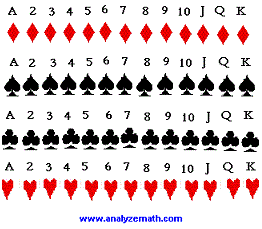
Let E be the upshot "getting the 3 of diamond". An examination of the sample space shows that there is i "iii of diamond" so that n(E) = 1 and n(South) = 52. Hence the probability of event Due east occurring is given by
P(E) = 1 / 52
Question vii
A card is drawn at random from a deck of cards. Detect the probability of getting a queen. Solution to Question seven
The sample space Due south of the experiment in question vii is shwon above (see question 6)
Let E be the event "getting a Queen". An examination of the sample space shows that in that location are 4 "Queens" so that n(E) = four and n(S) = 52. Hence the probability of event E occurring is given by
P(E) = iv / 52 = 1 / 13
Question 8
A jar contains 3 cerise marbles, 7 green marbles and 10 white marbles. If a marble is drawn from the jar at random, what is the probability that this marble is white? Solution to Question 8
Nosotros offset construct a tabular array of frequencies that gives the marbles color distributions as follows
| color | frequency |
|---|---|
| ruddy | 3 |
| dark-green | 7 |
| white | 10 |
We now employ the empirical formula of the probability
P(East) = Frequency for white color / Full frequencies in the above table
= 10 / 20 = one / 2
Question 9
The blood groups of 200 people is distributed as follows: 50 take type A blood, 65 have B blood type, lxx take O blood type and 15 accept blazon AB claret. If a person from this group is selected at random, what is the probability that this person has O claret type? Solution to Question 9
We construct a table of frequencies for the the blood groups as follows
| grouping | frequency |
|---|---|
| a | 50 |
| B | 65 |
| O | seventy |
| AB | 15 |
We apply the empirical formula of the probability
P(E) = Frequency for O blood / Total frequencies
= 70 / 200 = 0.35
Exercises
a) A die is rolled, find the probability that the number obtained is greater than 4.
b) Ii coins are tossed, find the probability that 1
only is obtained.
c) 2 dice are rolled, discover the probability that the sum is equal to 5.
d) A menu is drawn at random from a deck of cards. Find the probability of getting the Rex of heart.
Answers to higher up exercises
a) 2 / 6 = one / 3
b) 2 / 4 = ane / 2
c) 4 / 36 = 1 / 9
d) 1 / 52
More References and links
elementary statistics and probabilities .
Home Page
DOWNLOAD HERE
Posted by: carmichaelpappin.blogspot.com



0 Komentar
Post a Comment